
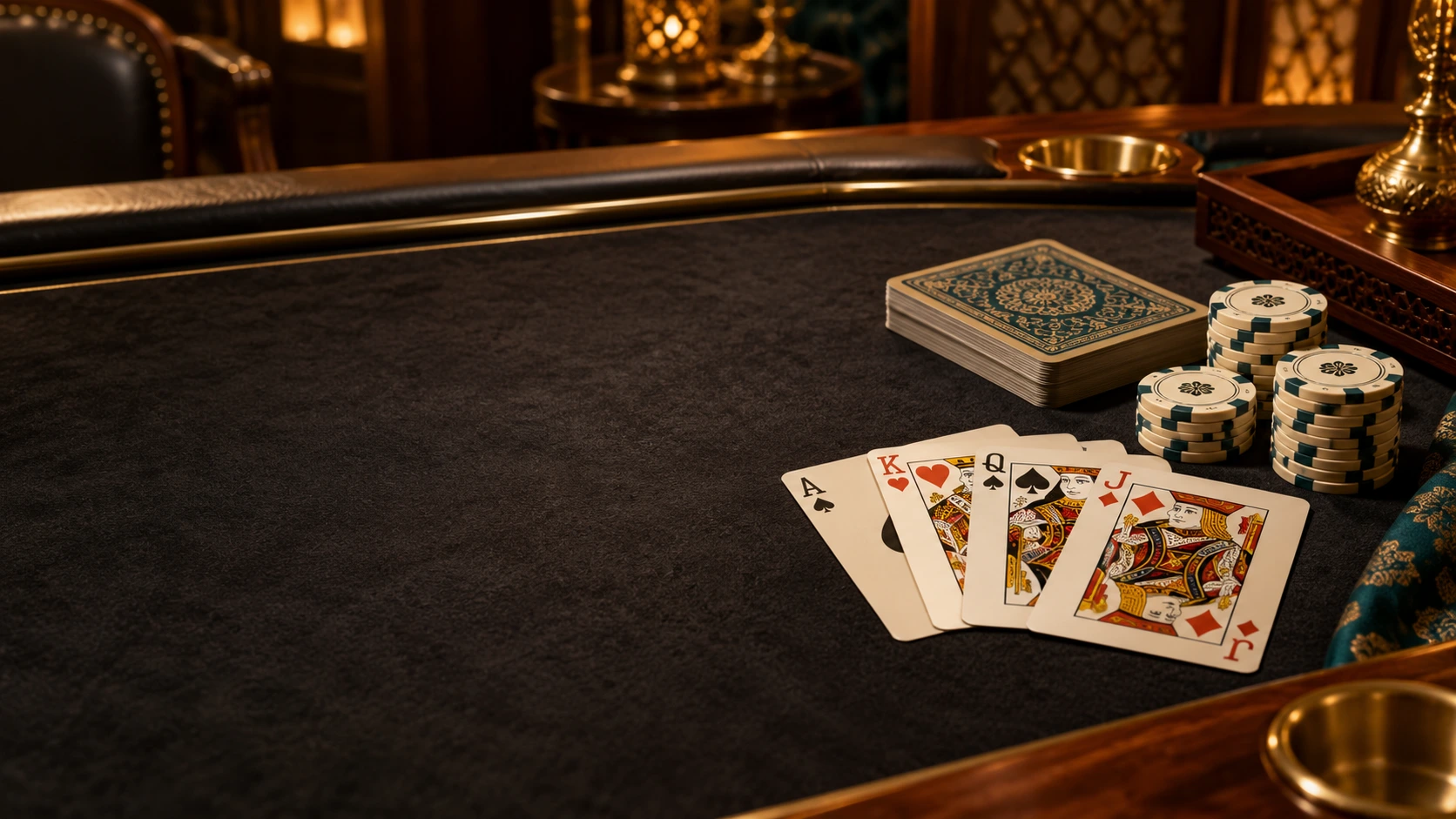
Planbet lists Teen Patti, Andar Bahar and Rummy beside slots, live tables and cricket. This page works through the mechanics that decide a card result, so you can read a table before you take a seat and check the stake against the rule that will settle it. Each worked example below is hypothetical and was assembled to test a rule, not drawn from a live table.
Start from the Planbet homepage, open the card-game or live-table lobby, and select the format you want. The notes here show what to verify once that lobby screen is in front of you.
Choose your Teen Patti table
A traditional Teen Patti hand holds three cards. The common ranking published by Octro runs downward from trail, pure sequence, sequence, colour, pair, to high card. A trail is three of one rank; a pure sequence is three consecutive ranks in one suit; a sequence keeps consecutive ranks across mixed suits; a colour is three of one suit without a run; a pair is two of a rank; high card is the remainder.
Read the list as a ladder. Each hand is tested from the top, and the first category that fits is the answer. A trail of sevens also contains a pair, but the trail sits above the pair, so the pair is never reached.
The four hypothetical hands below each fall into exactly one category.
| Hand | Cards | Category | Reason |
|---|---|---|---|
| A | 7♠ 7♥ 7♦ | Trail | Three of one rank |
| B | 5♣ 6♣ 7♣ | Pure sequence | Consecutive, one suit |
| C | 9♠ 10♥ J♦ | Sequence | Consecutive, mixed suits |
| D | 4♥ 8♥ K♥ | Colour | One suit, ranks not consecutive |
Hand D is the common misread. Three hearts look tidy, but the ranks 4, 8 and K have gaps, so the hand is a colour. A sequence needs both a continuous run and one suit. Hand C catches the other error: different suits do not disqualify a run, so 9, 10 and J still rank as a sequence, below a pure sequence.
Change one card and the ladder can move. Swap J♦ for 5♥ in the same hypothetical hand and you hold 9♠ 10♥ 5♥. No repeat rank and no run remain, so the hand drops to high card, read from its top card. One swap moved it three rungs down.
Ace runs are where the ranking stops being tidy. The Octro page carries conflicting order information for A-K-Q and A-2-3, so treat Ace order as variant-dependent and read the table’s own rules before staking. Open Play Indian cards to reach the relevant route, and confirm the room’s stake and banker rules on the table screen.
A short offline check settles most hands: count to three, look for repeats and runs, note the suits, assign the category, then compare the named table rules on Ace order and ties.
Play Andar Bahar with the named variant
Andar Bahar deals one reference card, then distributes cards to two labelled sides. The first card whose rank matches the reference rank closes the game. Rank is the only trigger: a queen reference is answered by another queen, not by a king or jack just because all three are court cards.
Suppose the reference card is 8♦ and, on an explicit first-side assumption, the trace runs: Andar 3♣, Bahar 8♥. The second card matches the rank, so the game closes on Bahar under that assumption. The assumption matters. The Evolution product named Super Andar Bahar starts on Andar; do not carry that behaviour across to other products, including any KA Gaming reference-card table you may be offered.
Trace a longer hypothetical game. Reference 8♦ with the same first-side assumption: Andar 3♣, Bahar Q♠, Andar 5♥, Bahar 8♣. The first three cards repeat no rank, so play continues. The fourth card matches and closes on Bahar. The count before the match is not the result; the side that drew the matching rank is.
A note that says only “Bahar” tells you nothing useful. A usable record contains the reference rank, the side label of each dealt card in order, and the matching card. The reference rank is the fixed point of the round, so check it before you stake. Before joining, confirm which side opens and whether the table’s side rules differ from what you expect. Open the live casino route to see the table list and terms; the game name on the table card should match the variant you have read.
Build a Rummy hand before you join
In the identified 13-card format published by RummyCircle, every card must be grouped and a valid declaration needs at least two sequences, at least one of them pure. A sequence runs consecutive ranks in one suit; a set holds one rank across different suits. Joker rules belong to the variant and decide whether a substitute can occupy a slot in a sequence or group.
Consider a fully enumerated hypothetical hand:
4♥ 5♥ 6♥ 7♥ · 9♣ 10♣ J♣ · Q♠ Q♥ Q♦ · 2♠ 3♠ 8♦
Grouping card by card gives four groups. Group 1 is 4♥ 5♥ 6♥ 7♥, four consecutive hearts. Group 2 is 9♣ 10♣ J♣, three consecutive clubs. Group 3 is Q♠ Q♥ Q♦, three queens in different suits. Group 4 is 2♠ 3♠ 8♦. The count is 4 + 3 + 3 + 3 = 13, with no card used twice. Groups 1 and 2 are sequences, and Group 1 is pure because it uses no substitute. That meets the stated minimum of two sequences with one pure, assuming the variant accepts the final mixed group as a permitted shape.
Change exactly one card. Replace 8♦ with 8♠ and the last group becomes 2♠ 3♠ 8♠. Those are three spades with a rank gap, so the group is neither a sequence nor a set. The two required sequences still exist, but one group no longer fits a permitted shape. The error is visible without any judgement about how well the hand would play.
Keep the two ideas separate. A sequence is built along a suit; a set is built across suits at one rank. A pure sequence uses natural cards; a substituted sequence uses a joker allowed by the variant. The same thirteen cards can produce a valid declaration and a failed one on a single substitution, so check the joker scope before you stake.
A short ordered audit works well:
- Spread all thirteen cards and confirm the total.
- Mark each pure sequence and note its length.
- Identify a second sequence and check whether it is pure or substituted.
- Group the rest into sets or permitted sequences, accounting for every card once.
- Confirm the variant’s joker and declaration conditions.
A tidy-looking table is not proof of eligibility. The audit checks the grouping arithmetic; the variant decides what the rules accept. Open Play Rummy on Planbet when you are ready to select a table, and read the stake and declaration terms on that table card.
Match the card game to the table rules
| Format | Question | Observable evidence | Rule left to the variant |
|---|---|---|---|
| Teen Patti | Which hand ranks higher | The three cards of each hand | Ace-run order and tie handling |
| Andar Bahar | Which side drew the rank match | Reference rank, side labels, dealt order | Opening side and side rules |
| Rummy | Whether thirteen cards declare | Full grouping with every card placed once | Joker scope and declaration details |
A hypothetical result record fixes the cards, not the settlement. It shows what was grouped or dealt and how a rule was applied in that example. Anything beyond that depends on the variant actually in play, which is why every section above ends with a rule check rather than a verdict.
For local payments, the supplied profile names UPI deposits and an INR balance; confirm availability, limits and processing times in the current terms before you transact. Open UPI and INR terms to review those conditions alongside your account controls. The welcome offer of up to ₹30,000 plus 150 free spins is described in the source material only; eligibility, wagering and expiry follow current terms, so read the offer page before opting in. Open View welcome offer from the lobby for the live details.
Cricket betting, slots and live casino titles sit beside these card formats on the same service. Availability of any category follows current terms, and named external games are attributed mechanism examples, not confirmed Planbet inventory. Adult readers aged 18 and over should set time and spend limits before play and treat card games as carrying financial risk.